
What’s Behind the Stairs? A Gilded Age Kitchen Story.
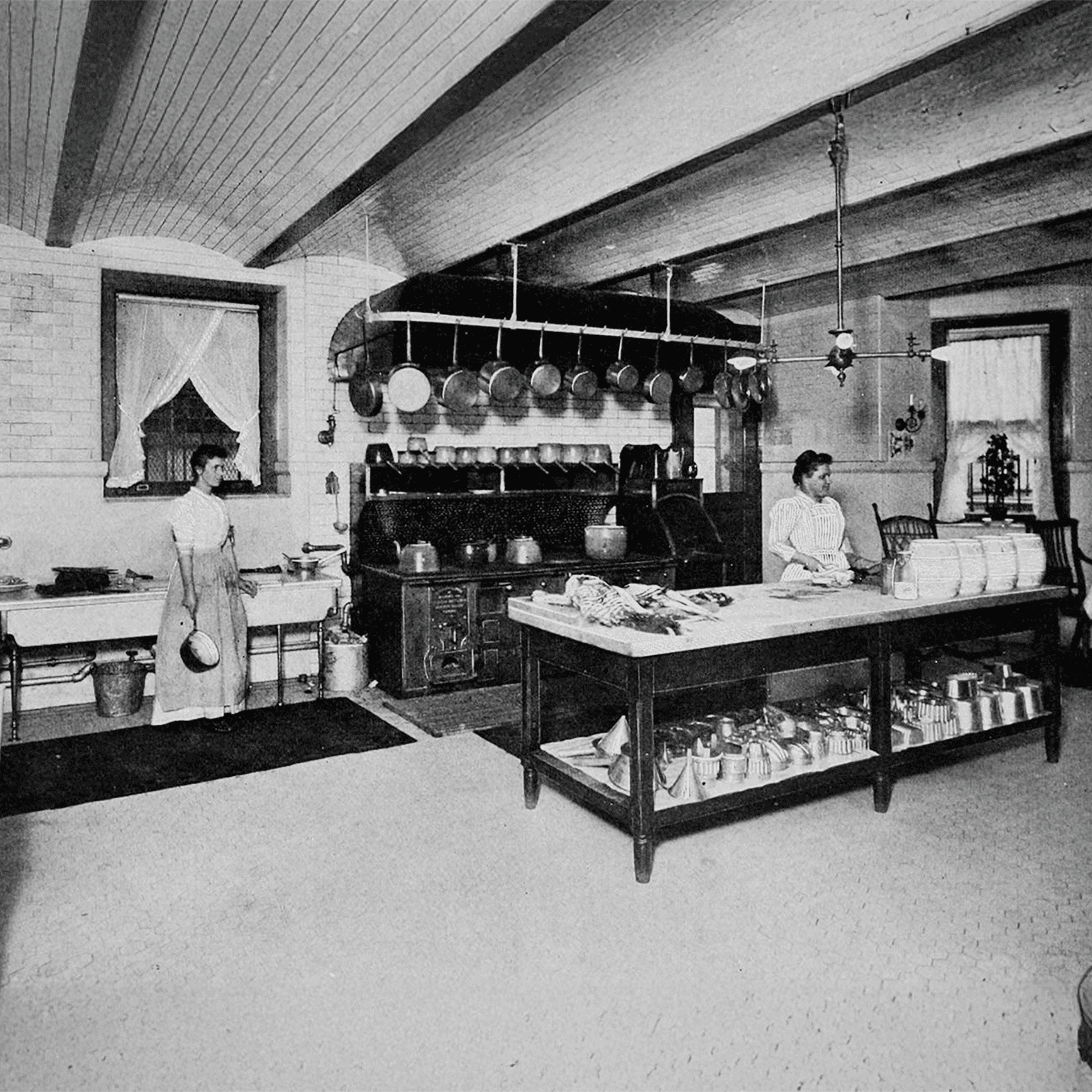
Let’s go back in time to New York in the late 1800s. It’s about 6 pm, just an hour before the guests arrive. Imagine the cacophony of noise, chaos, people running around and fussing. Upstairs, a beautifully set table waits, draped in silk and lit with candlesticks. This is the Gilded Age kitchen.
The Chef Is King
A sumptuous dinner lives or dies by one person, and that is the chef.
In a Gilded Age mansion, the chef de cuisine was a trophy. Yes, you read that right. A good French chef could earn $100 to $180 a month; a housemaid took home $18 to $25. That salary alone put him ahead of most physicians of the era. He was often the highest-paid person in the entire household. New money families hired a chef because everyone who mattered would know they had. Now that was a status move.
Why did he have to be French? By the 1880s, French meant legitimacy. Auguste Escoffier was busy codifying haute cuisine in Europe. His influence spread across the Atlantic in no time. Without saying a word, a household with a French-trained chef was announcing that its money had refined manners. This mattered. The sauces and multi-course meals go back to a French-cuisine style that few Americans had access to. Owning that expertise was the point.
*This post contains affiliate links. If you make a purchase through these links, I may earn a small commission at no additional cost to you. I earn from qualifying purchases. Thank you for supporting this site and helping me keep ancient food stories alive. Learn more.*
Hierarchy Below Stairs
While upstairs had place cards and rank-ordered seating. Downstairs had its own hierarchy.
A Gilded Age mansion kitchen relied on a structure that Escoffier was already implementing in European hotel kitchens. At the top, a chef de cuisine, a sous chef beneath him, then cooks assigned to specific tasks. Followed by kitchen maids, scullery maids in charge of the dirtiest and lowest-status work. A separate pastry room had its own chef. Desserts are another specialty. At The Breakers in Newport, the pastry team alone was an “army.”
The rules were not casual. Service had an equally rigid hierarchy. The butler, at the top of the male staff, managed wine, silver, and footmen. The housekeeper held a similar authority over the female staff. The staff met at the kitchen door, where plated food changed hands from those who made it to those allowed to be seen carrying it.
The rules were not casual. Domestics were not to speak unless spoken to, and personal opinions had no place in front of an employer. The dining room ran on careful choreography. The kitchen staff followed something close to military order.
Timing Was an Art in a Gilded Age Kitchen
Then there’s the timing! Getting seven courses for twenty or more guests, each course piping hot, in the correct order, without a single one being early or late, was a logistical feat. And they did it all without the tools we take for granted today.
To coordinate this huge effort, they relied on basic technology like the clock, memory, and simple relays. Dumbwaiters carried plated food up from basement kitchens to service floors above. Finished dishes sat on warming tables while the rest of a course was assembled. Footmen and butlers timed their entrances into the dining room to a rhythm set in the kitchen. There, a coal-fired range, sometimes twenty feet long, would cook a poached whole fish, or a roast. At the same time, a delicate sauce would require a different heat temperature.
A slight slip and the choreography upstairs would completely fall apart. Imagine how that would make the hostess look? Would the guests notice?
What Did the Staff Eat?
While the elegant upstairs diners worked their way through oysters and roast game dressed in truffle sauce, the people downstairs were not offered this privilege.
Domestics’ meals were simple and repetitive. They featured salted cheap cuts of meat and inexpensive fish. Vegetables like potatoes, greens, and puddings sweetened with treacle were the norm. One 1892 account of a staff member put it very bluntly: the household bought “special things” for the servants because they weren’t expected to eat what the family ate. The quality was “very much less in cost.”
The particular cruelty of a kitchen job was proximity to this elaborate luxury. The kitchen staff would plate foie gras and Bordeaux-soaked roasts for the dining room, but sat down to stew and bread. They handled the finest ingredients New York money could buy, and touched almost none of it. That’s how a Gilded Age kitchen operated.
Those Hours Took a Toll
You could clock out of this shift at any time.
Domestic staff routinely worked 14- to 18-hour days. As a live-in, this meant the job followed you upstairs. At all times, to a shared bedroom on the mansion’s third or fourth floor. Days off were rare, sometimes half a Sunday. During the social season, those dinners and balls that built a family’s reputation took place; your half day could disappear. Roughly 16 percent of New York City’s population worked in domestic service during this period.
Irish immigrants dominated many Gilded Age kitchens in the Northeast, alongside German, Scandinavian, and Chinese workers. But across the country, Black workers also formed a vital part of domestic service, though their labor carried a very different history. This one was rooted directly in the legacy of slavery. The American system was far more complex than the English servant model so admired by the wealthy.
The elegance upstairs had a cost; it was in hours, not dollars.
The Forgotten Ones
Every detail in that Fifth Avenue dining room was served and cooked by people whose names never once appeared in the society pages. Opulence on every plate. Invisible labor behind every course. Both of the things were at the same table, at the same moment, and only one of them made the papers.
But in this article, I pay tribute to all of them.
Explore more in our Food Spotlights or subscribe to our newsletter for weekly stories and recipes inspired by history. Taste the rest of the story.
Selected Sources and Further Reading
- National Geographic — These mansion museums reveal the grittier side of the Gilded Age
- Smithsonian Magazine — The True History Behind HBO’s ‘The Gilded Age’
- Ephemeral New York — All the servants of a rich Gilded Age household
Image Sources
- Acland household servants, 1897. Photograph by Sarah Angelina Acland. Public domain, via Wikimedia Commons
- A Cook and Second Cook in a model kitchen, from Mrs. Seely’s Cook-Book (1902). NPS Photo.
Note to my readers:
My research draws on travel experiences, books, and, sometimes, AI tools. I love using my own photos whenever possible, but occasionally I include stock or AI-generated images to help illustrate the story.
Still Intrigued By The Menu?
Subscribe to our newsletter for the freshest bites of food history, culture, and exclusive features.
Still hungry for history?




Let’s Connect
About Food Culture Bites

Food Culture Bites is a food history and culture website dedicated to exploring how food becomes identity. We tell the stories behind the dishes and traditions that shape past and present communities. Read more.>
Meet Janette Speyer

Behind every bite, there’s a story. Join me on a journey through history to explore how centuries of culture have shaped the way we eat. Read More >
Meet Bob Speyer

Bob Speyer is a writer and contributor to Food Culture Bites, bringing a lifetime of global experience, storytelling, and cultural insight to the publication. Having traveled to more than 60 countries, Bob writes with a deep appreciation for how history, food, and human connection intersect across cultures. Read More >