
The Spanish Paella I Grew Up With Was Wrong.
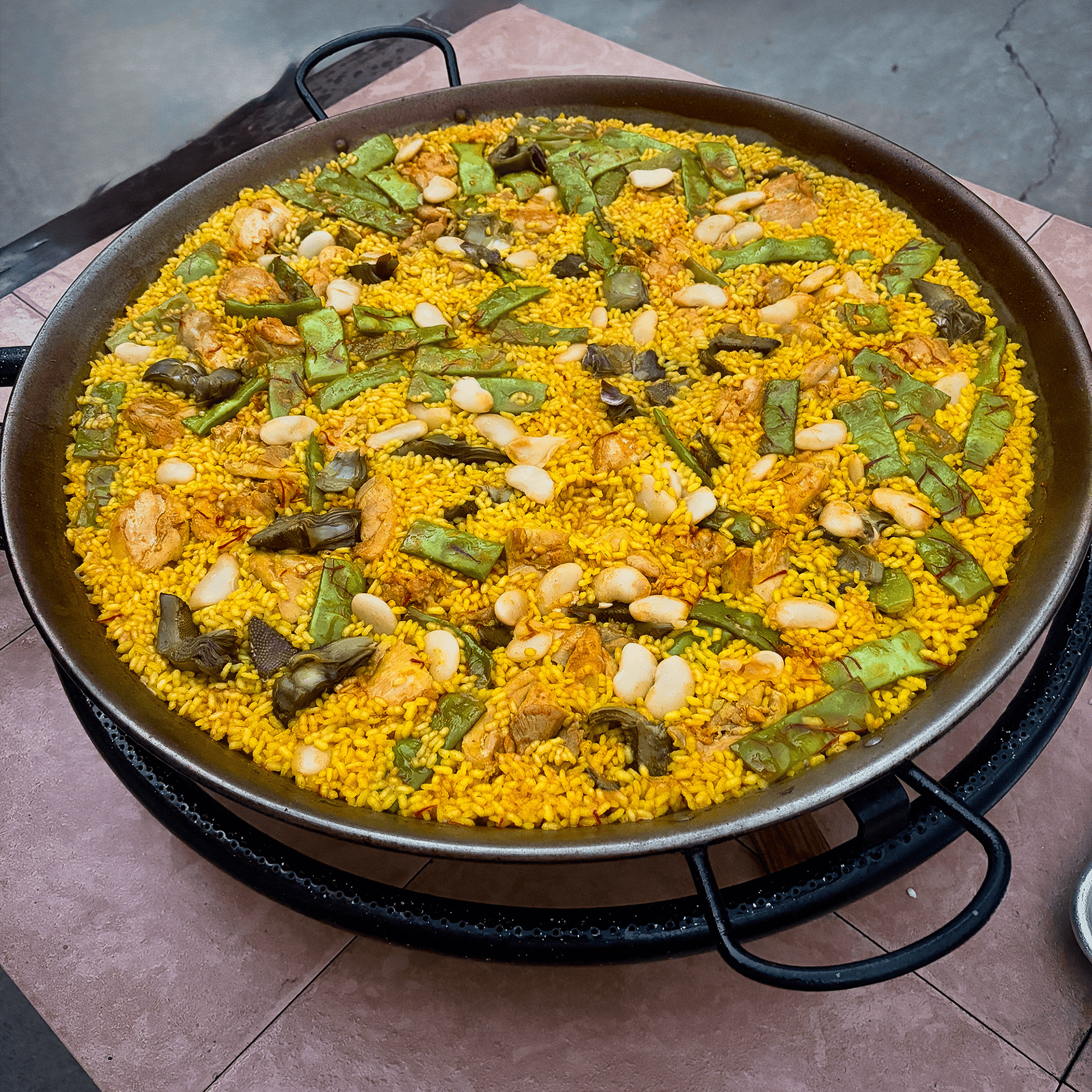
The Spanish paella of my childhood in Caracas had chorizo. Chicken, shrimp, artichokes, peppers, and chorizo. That’s how I understood paella. It never occurred to me that anyone would object.
Then I started researching this article and spoke with my friend Manena Fayos, a chef and the daughter and granddaughter of Valencians. The paella saga began.
Was the paella I grew up with somehow less authentic?
I often visit Spain and eat paella. I’ve tasted all kinds of Spanish paella: Valenciana, Sevillana, and De mariscos.
*This post contains affiliate links. If you make a purchase through these links, I may earn a small commission at no additional cost to you. I earn from qualifying purchases. Thank you for supporting this site and helping me keep ancient food stories alive. Learn more.*
What is authentic paella?
Few dishes inspire as much passion as a Spanish paella. Mention pineapple on pizza, and you’ll start an argument.
Mention chorizo in authentic paella, and you’ll start a war.
It’s that serious!
Paella is one of Spain’s greatest and most protected culinary symbols. The dish originated in the wetlands of Valencia, where humble farmers cooked over orange wood beside the rice fields.
Rice Changed Spain Forever
In the 8th–10th centuries, rice was already beginning to change Spain.
The crop was cultivated in the Mediterranean before the Islamic conquest of Iberia. But it was not a major crop in pre-Islamic Spain. Large-scale harvesting in Valencia began in the Muslim period.
Arab-Islamic agriculture brought sophisticated irrigation and water-management techniques to eastern Spain. Parts of the landscape were transformed to enable intensive agriculture. One region benefited enormously: the wetlands surrounding Valencia.
Today’s Albufera Natural Park rice paddies provide ideal conditions for rice cultivation. Over the centuries, this area became one of Spain’s most important rice-growing regions. Even today, some of the rice used for traditional Valencian paella is from Albufera, with varieties like Senia, Bomba and Albufera.
The connection between rice and paella is fundamental. Albufera, besides being beautiful, is at the heart of the region’s rice-growing and culinary heritage.
This is the history that matters when we talk about authentic paella.
The paella we know today might never have existed without the agricultural transformation brought by Muslim Spain.
What Is Paella Anyway? Is It a Dish Or a Pan?
I know, just like me, you may think paella is the dish itself. Well… a little research uncovered that paella is actually the pan.
According to Manena, the word paella comes from the wide, shallow pan traditionally used to cook the dish. Its name is generally traced to the word padella, meaning a shallow pan or dish, which evolved over centuries into the Valencian word paella.
In other words, the dish is named after the cookware, not the ingredients.
And that little linguistic detail tells us something important about paella.
The shallow pan allows for a thin layer of rice, meaning fast evaporation during cooking; this is what makes socarrat possible and why stirring ruins it.
If you understand the pan, you will understand the dish.
Paella Began as Farmers’ Food
The first recognizable paellas appeared around the 18th century in rural Valencia. Farmers spent long days harvesting rice and tending orange groves. They gathered at lunchtime around an open fire and cooked whatever they could find.
Some of the ingredients added to the rice were rabbit, chicken, and snails. Before the 19th century, marsh rats sometimes made their way into the pot. For vegetables, they added green beans, butter beans (“Garrofó”), and tomatoes. All this was cooked in fresh olive oil and seasoned with saffron and salt. And there you have it! Everything cooked together in a single pan over burning orange branches.
Paella is where two landscapes meet in one pan. The rice comes from the water, the Albufera marshes the Moors turned into paddies. The meat comes from the dry land right beside it: rabbit from the scrub, snails gathered off the bushes. Farmers cooked what was underfoot in both directions.
This is the authentic Paella Valenciana like no other.
Note: no seafood, no peas, no chorizo, and no red peppers.
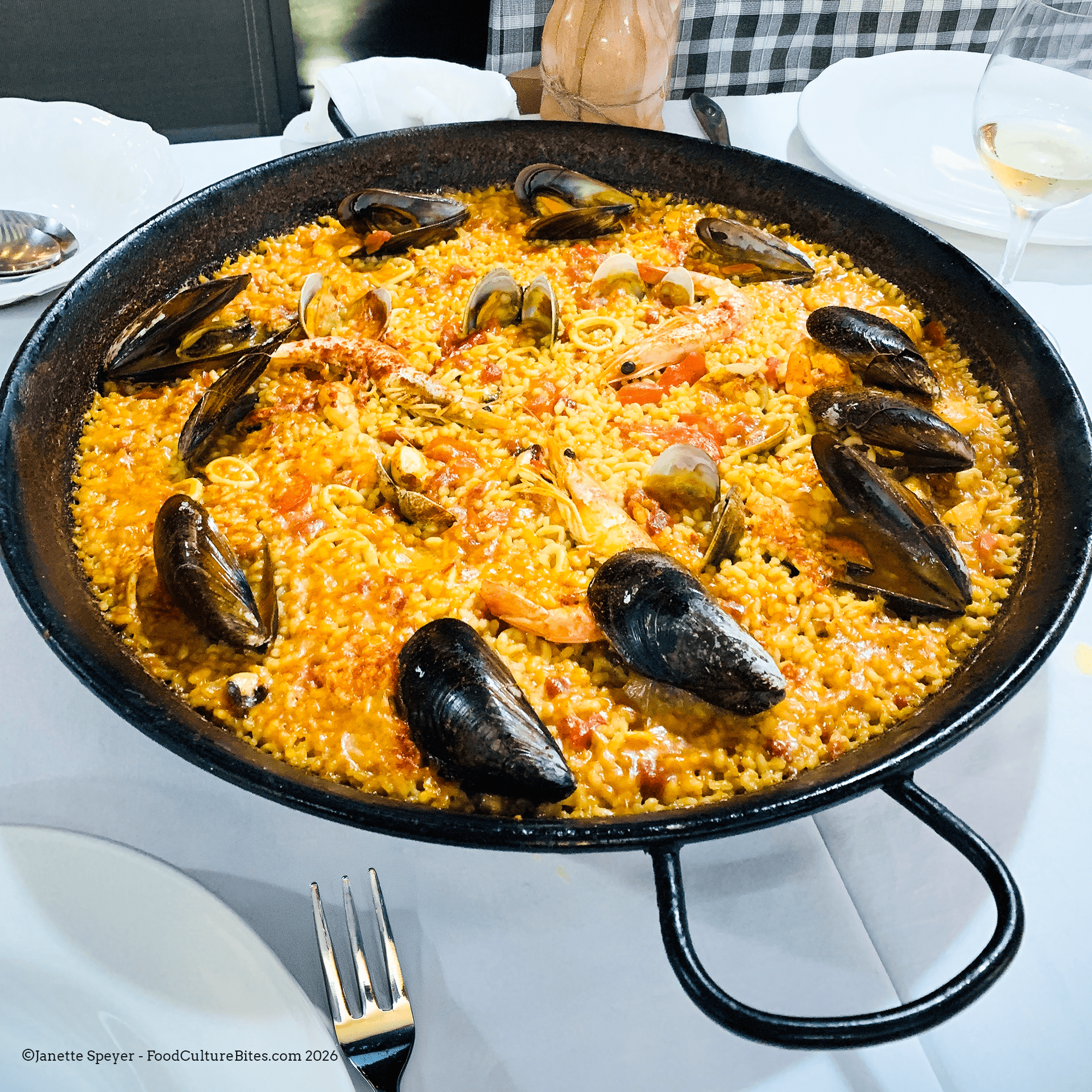
Seafood Paella -Paella de Mariscos.
Why Seafood Paella Then?
Since Valencia is on the Mediterranean, it’s logical that the dish evolved as it moved towards the coast. Fishermen naturally substituted seafood for rabbits. Over time, they added shrimp, mussels, clams, squid, and cuttlefish. This is how the Paella de Marisco, or Seafood Paella, came to be. Another popular variation is Paella Mixta, which includes meat and seafood.
Manena tells me that Valencian purists claim that Paella de Mariscos is not really a paella but just a rice dish. There is also “arroz del senyoret,” meaning “gentleman’s rice,” made with fish or seafood broth. The seafood is fully cleaned so posh gentlemen won’t mess their hands while eating.
Many tourists think mixed paella is “traditional,” but Valencianos consider it a compromise. Manena simply refers to these rice dishes as a compromise, not authentic.
What About Paella Sevillana?
This gets interesting and complicated all at once. Unlike Valencian paella, there is no centuries-old traditional recipe called Paella Sevillana.
Instead, restaurants in Seville often prepare their own regional creative dishes.
Some recipes include chicken, shrimp, and sometimes chorizo as the meat base. Vegetables include locally grown peppers, peas, artichokes, and whatever else is available.
Seville has a rich rice tradition, but many local rice dishes are actually arroces (rice with mixed ingredients) rather than classic paellas. These “arroces” reflect Andalusian tastes rather than an officially recognized historic recipe.
Paella Sevillana may appear on menus, but it doesn’t have the same historical status as Paella Valenciana.
Arroz con Cosas: When Paella Becomes “Rice with Things”
There is a wonderfully blunt Spanish expression for what happens when you put almost anything into a pan of rice and call it paella:
“Arroz con cosas” literally means “rice with things.”
Valencians often use the expression humorously or dismissively for dishes labeled paella that stray too far from the traditional Valencian dish.
Put chorizo in it? Add peas, bell peppers, or a handful of whatever happens to be in the refrigerator? Throw chicken and seafood together? To many Valencians, you may have created a perfectly delicious rice dish.
But as you read earlier, this is not a Paella Valenciana.
Valencia has its own protected regional variations. Some versions include duck, snails, artichokes, or local meatballs, depending on where you are in the region. So authenticity isn’t simply a matter of following one rigid recipe. Rather, it is about tradition, local ingredients, and cultural identity.
Outside Spain, however, paella has become its own category, a wide pan of rice with whatever ingredients the cook considers Spanish.
¿Y Chorizo, Qué? My Childhood Paella
In Venezuela, paella developed its own identity. Chicken, chorizo, shrimp, artichokes, and peppers all made their way into the pan.
This was the paella of my childhood.
And yet, outside Valencia, chorizo has become almost synonymous with “Spanish paella.”
Manena, whose father and grandparents are Valencian, can quite reasonably say: “That isn’t Paella Valenciana.”
A Venezuelan can just as reasonably say: “That is the paella I grew up with.”
Both are right. Paella Valenciana is the traditional Valencian dish with a specific history, place, and culinary identity. But when immigrants carried paella across oceans and adapted it to their new homes, they weren’t destroying a tradition.
They were creating new ones.
The Secret to Great Paella
If you are making an authentic paella, you must respect the rice. Authentic paella isn’t about piling on ingredients.
Valencianos follow a few important rules:
- Use short-grain Spanish rice such as Bomba or Calasparra.
- NEVER stir continuously.
- Cook in a paella pan.
- Allow the liquid to evaporate naturally.
- Let the socarrat develop. That’s the best part!
- Rest the paella for several minutes before serving.
Most of all, you’ll need a large supply of patience! The secret is in the trial and error.
I’m still trying to get this paella right!
A quick note worth mentioning. Who gets the socarrat?
Everyone wants it! What is it?
Socarrat is the bottom layer of the pan. It isn’t just burned rice; when it’s done right, it’s toasted, caramelized rice with concentrated flavor. Scraping up the best bits is almost like a competition! Just a small warning: if you eat paella with me, I want it! You can keep the chorizo.
A Culture and a Community
Paella is not an everyday dinner. Because it requires so much prep time, it’s served on Sundays, holidays, and special family celebrations.
Traditionally, it’s prepared outside; cooks tend the fire while everyone gathers nearby.
In many Spanish families, making paella is about community, family, and spending time together as well as eating. And as paella goes, so does la familia!
About our contributor for this article
Manena Fayos is a Spanish and Mediterranean chef born and raised in Madrid with a Valencian father and grandparents. Manena is also an accomplished flamenco dancer and a professional language interpreter.
Authentic Spanish Paella cooked by Manena Fayos and photographed by Julie Drucker.
Explore more in our Food Spotlights or subscribe to our newsletter for weekly stories and recipes inspired by history. Taste the rest of the story.
Selected Sources and Further Reading
- Visit València’s official paella page – Would you like to try an authentic Valencian paella?
- EU Rice – El arroz de la DOP Arroz de Valencia
- National Geographic – From grain to plate: the story of Valencian paella and its homegrown, world-class rice
- The Gab Lab, Gastronomic Arts Barcelona – Difference Between Valencian and Barcelona Paella Guide
- Nothing Familiar, Brigitte and Jake – El Palmar Valencia: Our Paella Feast & Albufera Boat Trip Guide
Note to my readers:
My research draws on travel experiences, books, and, sometimes, AI tools. I love using my own photos whenever possible, but occasionally I include stock or AI-generated images to help illustrate the story.
Still Intrigued By The Menu?
Subscribe to our newsletter for the freshest bites of food history, culture, and exclusive features.
Still hungry for history?
Let’s Connect
About Food Culture Bites
Food Culture Bites is a food history and culture website dedicated to exploring how food becomes identity. We tell the stories behind the dishes and traditions that shape past and present communities. Read more.>
Meet Janette Speyer

Behind every bite, there’s a story. Join me on a journey through history to explore how centuries of culture have shaped the way we eat. Read More >
Meet Bob Speyer

Bob Speyer is a writer and contributor to Food Culture Bites, bringing a lifetime of global experience, storytelling, and cultural insight to the publication. Having traveled to more than 60 countries, Bob writes with a deep appreciation for how history, food, and human connection intersect across cultures. Read More >