
What Did Pirates Really Eat?

Pirates have been packaged as a meal themselves. And every schoolkid knows the lyric… “Ho Ho Ho and a Bottle of Rum.”
We have all fantasized about a pirate’s life at sea. Hollywood presents us with images of wooden tables topped with roasts, tropical fruit, and overflowing mugs of rum. And there’s always that treasure chest somewhere in the vicinity.
But the reality was far less appetizing.
For most sailors during the great age of sail, food was for survival. Everything brought on board had to weather heat, humidity, and salt air. And then there were the rats (eek!), the mold, and months of storage.
And pirates had the exact same problem as any sailor at sea. They also needed to eat.
*This post contains affiliate links. If you make a purchase through these links, I may earn a small commission at no additional cost to you. I earn from qualifying purchases. Thank you for supporting this site and helping me keep ancient food stories alive. Learn more.*
The Pirate Food Myth
The popular image of the pirate feast isn’t entirely fictional. Once pirates reached land, they could enjoy fresh meat, fruit, fish, and other foods that were difficult to keep aboard ship. They could also acquire provisions by capturing well-stocked merchant vessels.
But at sea, pirates faced many of the same practical problems as other sailors. Food had to survive long periods without refrigeration, often in hot, damp conditions. As a result, the provisions aboard pirate ships were shaped less by culinary preference than by what could be stored and carried.
Historical evidence suggests that pirates relied on many of the same durable provisions found aboard other sailing vessels: ship’s biscuits, salted or dried meat, dried legumes, and alcoholic beverages. Contemporary accounts and archaeological evidence also show that pirate crews obtained fresh provisions when they could via fishing, livestock, trading, raiding, or reaching port.
In other words, there probably wasn’t a special “pirate diet.” The sea dictated the menu.
Hardtack, the Survival Biscuit
If one food symbolized life at sea, it was ship’s biscuit, also known as hardtack.
Made from flour, water, and salt, it was baked into a very dry, hard biscuit. The idea was to remove as much moisture as possible because moisture or mold meant spoilage.
It was supposed to last and nothing more.
The ship’s biscuit had a long history. Voyages carried versions of preserved hardtack centuries before the Golden Age of Piracy. By the eighteenth century, British naval provisions included substantial daily quantities of biscuit. Some of this sea bread survived after the ships and sailors were long gone. Archaeologists who recovered examples from shipwrecks got a tangible glimpse into what sailors actually ate.
There was a serious problem onboard.
Once these biscuits sat in a warm, damp ship’s hold for weeks, they could become infested with weevils and other pests. Sailors sometimes soaked or softened them in liquid before eating them.
Yes, as legend has it, pirate biscuits were real.
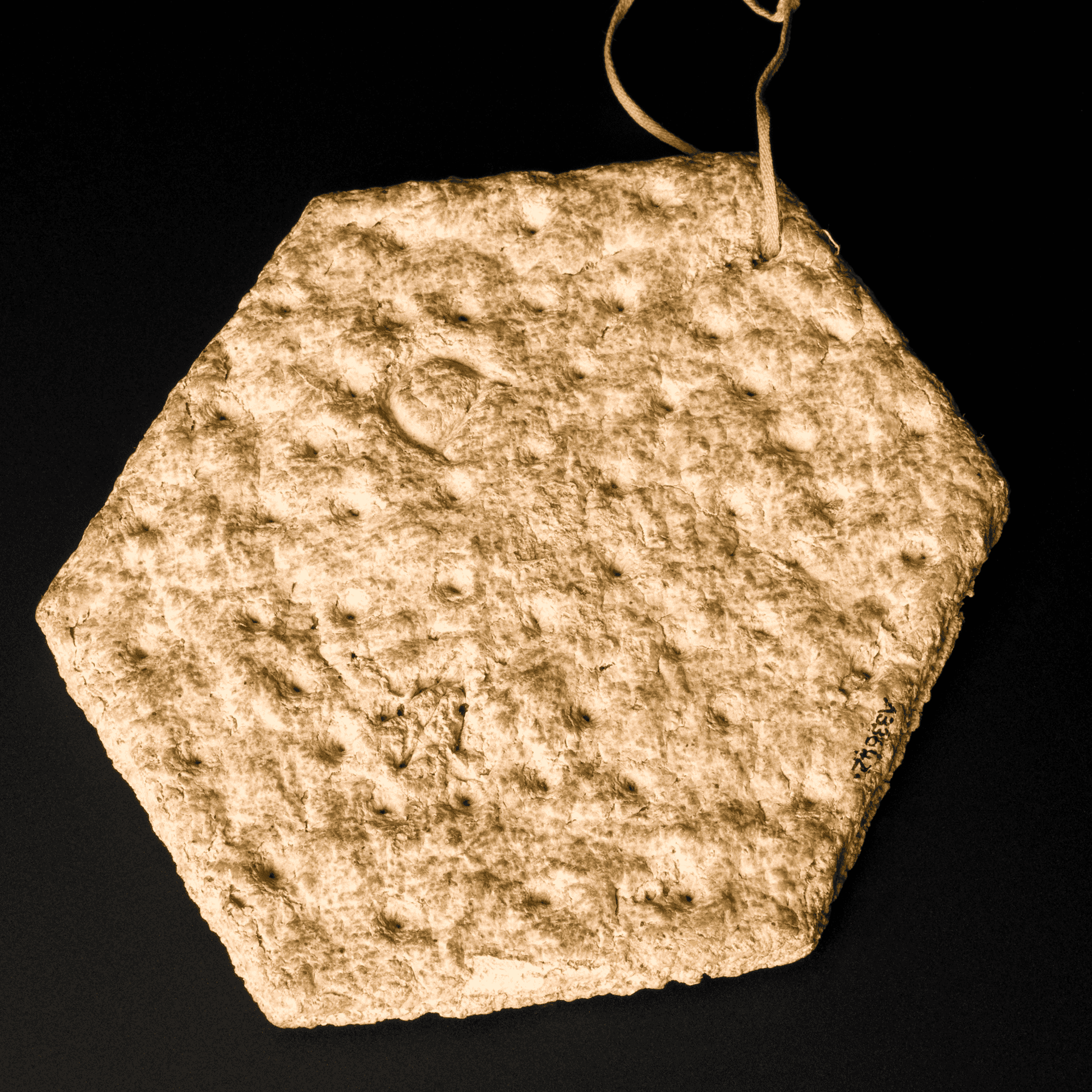
Science Museum, London. Wellcome Images [email protected] http://wellcomeimages.org Ship’s Biscuit was sometimes known as ‘hard tack’ because of its jaw-breaking toughness. It was a staple diet of sailors for centuries.
Copyrighted work available under Creative Commons Attribution only license CC BY 4.0
Food that Would Survive
Salted meats like beef and pork were other staples. Sailors packed meat into wooden casks and preserved it with salt. Salt drew moisture from the meat, making it possible to keep it for long periods without refrigeration.
The salt meat was tough and salty. It was so inedible that sailors often had to soak or boil it before eating.
A tough piece of salted pork was infinitely more useful than a fresh pork chop on a ship in the 17th or 18th century. Dried peas and other grains were equally valuable. These could be stored for long periods and cooked into protein-laden soups and stews.
The pirate’s pantry was built around a simple principle: If it couldn’t survive the voyage, it was not food.
So Did Pirates Eat Fresh Food?
Of course! But it was not very dependable. That kind of food was a treat.
Early on in a voyage, ships might carry fresh meat, vegetables, cheese, and other perishables. Some ships also carried livestock like chickens, pigs, goats, or sheep. These animals could provide fresh meat and eggs along the way.
Pirates also had another advantage: they could steal food. It was part of the trade, as was smuggling.
A captured merchant ship wasn’t always carrying gold. It might be carrying something far more valuable to a hungry crew: fresh food and drink.
The first thing pirates would do when reaching shore was get fresh fruit, vegetables, fish, meat, and other provisions.
At the end of the day, a pirate’s diet could be much more interesting. Especially in the Caribbean, where the ports are a short distance away.
One week might mean salted pork and hard biscuits. The next could be fresh fish, tropical fruit, and whatever else they brought onboard.
The Pirate Pantry Was a Battle Against Water
Water was a big problem onboard a ship. Fresh water stored in wooden casks could deteriorate over long voyages. Beer, wine, and spirits were essential parts of maritime life because alcoholic beverages are easier to store than water.
Rum became tied to sailors and pirates in the Caribbean. They could drink it straight, mix it with water, or add it to the sailors’ drink known as grog. So the pirate and his bottle of rum isn’t all Hollywood.
But rum wasn’t the whole story: preservation was.
The Scurvy Problem
The biggest enemy aboard ship that no amount of salted beef or hardtack could defeat was scurvy.
Long voyages with a diet heavy in preserved foods could devastate the whole crew.
British naval doctor James Lind linked scurvy with diet. He conducted a trial aboard HMS Salisbury in 1747. He found that sailors with scurvy who ate oranges and lemons recovered remarkably quickly. But the Royal Navy took decades to adopt citrus as a regular provision. Lind’s experiment showed that citrus fruits could dramatically treat scurvy. It would be nearly two centuries before scientists identified vitamin C, the nutrient lacking in people with scurvy, as the underlying cause.
Later, Cook’s 18th-century voyages proved further that keeping sailors healthy wasn’t simply about eating enough calories. What sailors ate mattered.
During his voyages, Cook emphasized cleanliness, ventilation, and getting fresh provisions whenever possible. His provisions included sauerkraut, malt, portable soup, and preserved fruit preparations. He made efforts to obtain fresh vegetables and fruit whenever he could.
Cook’s crews experienced far less scurvy than on many earlier long-distance voyages.
He did not yet understand vitamin C or the modern science behind the disease. But he had discovered something enormously important through observation:
Fresh food saved sailors’ lives.
What About the Famous Pirate Feast?
So, could a pirate captain really sit down to a table covered with roast meat, fruit and rum?
Yes, he can. Just not every night.
A successful raid could dramatically change what was available aboard ship. Captured vessels might provide fresh provisions, wine, spirits, sugar, spices, or other desirable foods.
And once ashore, pirates could eat much better than they did at sea. Let the real feast begin.
What Archaeology Tells Us About Pirate Food
I did some digging and found this very interesting bit of information. Archaeology can sometimes tell us what pirates really ate. When researchers excavated the wreck of Blackbeard’s Queen Anne’s Revenge off the coast of North Carolina, they recovered animal bones among the remains. Many came from young pigs, suggesting they may have kept live animals aboard to provide fresh meat. They also found cow bones and other evidence of food preparation. This is a glimpse into the pirate pantry, reminding us that behind the legends of buried treasures were practical concerns like keeping a crew fed at sea.
The Food of the High Seas
Pirate food tells us very little about the pirates themselves. But we do learn a great deal about the world they lived in.
Before refrigeration and modern food preservation, feeding people across an ocean was a huge challenge.
A barrel of salted pork, a sack of dried peas or a stack of hard biscuits might not sound like much. But to a sailor hundreds of miles from land, they were.
Because the greatest treasure on a pirate ship wasn’t always pieces of eight or gold bullion. It was food that was still edible.
Explore more in our Food Spotlights or subscribe to our newsletter for weekly stories and recipes inspired by history. Taste the rest of the story.
Selected Sources and Further Reading
- Royal College of Physicians of Edinburgh —James Lind
- Cambridge University Press — Bay salt in seventeenth-century meat preservation: how ethnomicrobiology and experimental archaeology help us understand historical tastes
- National Library of Medicine — Captain Cook’s beer: the antiscorbutic use of malt and beer in late 18th century sea voyages
Images:
- Sailing ships during the Age of Sail. Image: National Museum of the U.S. Navy, via Wikimedia Commons. Public Domain.
- Ship’s biscuit, England, 1875. Wellcome L0064860, CC BY 4.0, via Wikimedia Commons
Note to my readers:
My research draws on travel experiences, books, and, sometimes, AI tools. I love using my own photos whenever possible, but occasionally I include stock or AI-generated images to help illustrate the story.
Still Intrigued By The Menu?
Subscribe to our newsletter for the freshest bites of food history, culture, and exclusive features.
Still hungry for history?
Let’s Connect
About Food Culture Bites
Food Culture Bites is a food history and culture website dedicated to exploring how food becomes identity. We tell the stories behind the dishes and traditions that shape past and present communities. Read more.>
Meet Janette Speyer

Behind every bite, there’s a story. Join me on a journey through history to explore how centuries of culture have shaped the way we eat. Read More >
Meet Bob Speyer

Bob Speyer is a writer and contributor to Food Culture Bites, bringing a lifetime of global experience, storytelling, and cultural insight to the publication. Having traveled to more than 60 countries, Bob writes with a deep appreciation for how history, food, and human connection intersect across cultures. Read More >